
“Candour could not be more crucial to our creative process. Why? Because early on, all of our movies suck. That’s a blunt assessment, I know… Pixar films are not good at first, and our job is to make them so — to go, as I say, from suck to not-suck.”
The writer is Ed Catmull, co-founder of Pixar, one of the most famous animation companies in the world, along with Amy Wallace, an accomplished journalist and co-author. This single quote stopped me in my tracks and enticed me to read his 2014 best-seller, Creativity Inc. How could it not?
In the years since, we at CMG have become admirers of Creativity Inc. for the lessons it teaches us on the creative process. Founded in 1986, and later acquired by The Walt Disney Company in 2006, Pixar made history with Toy Story, the world’s first fully computer-animated feature film, and went on to produce memorable hits such as Finding Nemo, The Incredibles, Inside Out, and so many more. Perhaps its greatest achievement has been finding a way to make animated movies that appeal just as deeply to adults as they do to children — by blending humour, heart, and life lessons with stunning visual innovation and storytelling.
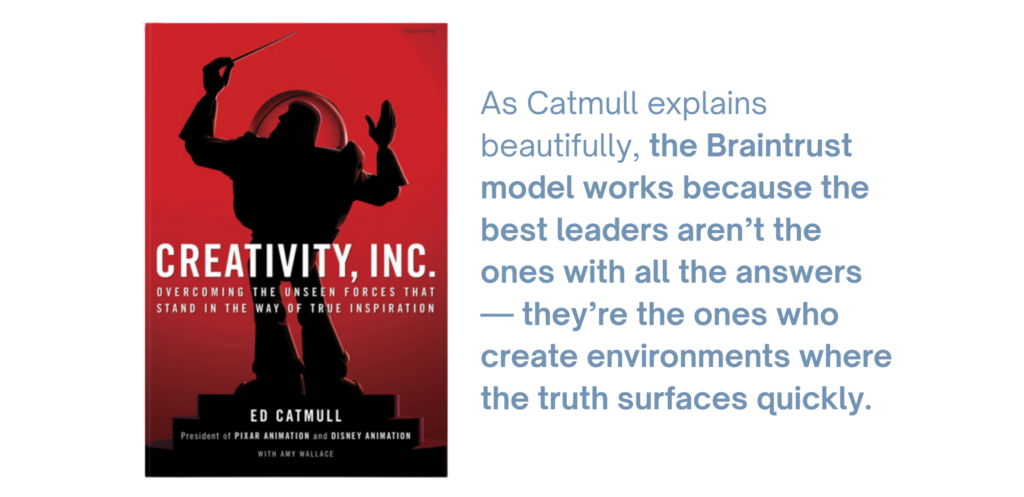
Catmull goes on to write in the same passage:
“We dare to attempt these stories… but we don’t get them right on the first pass.”
Does that sound familiar to you — not getting things right on the first pass?
Creativity Inc. is really about one simple core idea: that great companies are built less on brilliant ideas and more on environments where people can improve imperfect ideas together. Catmull argues that most organizations (of any type and across all sectors) “accidentally crush creativity” through fear, hierarchy, politics, and the pressure to appear “finished” way too early in the process.
Which leads me to my favourite concept in Catmull’s book — something he calls the “Braintrust.”
For Pixar, that means getting the right people into a room and introducing the latest ideas for its various films in production. The director (creator) of a film will typically bring in an early script (or rough cut) of the movie and ask for brutally candid “notes” from a group of peer directors, writers, producers, storytellers, and other creative people. There can be as many as 30 people weighing in. It’s real-time feedback in action.
What the director is really doing — early in the process — is asking for help in making an imperfect idea be better. A few factors make the Braintrust concept so impactful:
- The feedback is candid and direct.
- The discussion focuses on the work, not the person presenting the work.
- No one in the room has authority to force any changes to the work.
- The creator/director owns the final decision. (In other words: the movie is her baby! She gets to decide what happens next.)
This last point is critical.
The Braintrust isn’t decision-by-committee. It exists to surface blind spots, weak points, and (especially) better ideas. The creator leaves with clearer thinking, but still has ownership. As Catmull explains, the real magic comes from separating candour from control. People are more willing to be honest when they know they’re helping out, not taking over.
This is how Pixar makes its imperfect ideas better. It’s how it takes movies from ones that suck to not sucking.
We use our own version of the Braintrust at CMG. We try to deploy it on any important project or initiative — and our “directors” are called quarterbacks. For us, the Braintrust includes partners, advisors, financial modelers, underwriters, and various subject matter experts in many different domains. We especially love the Braintrust because it applies to practically any challenge or opportunity we’re facing. Indeed, we believe it’s suitable for any creative-focused team or enterprise.
And isn’t that practically anyone in business?
As Catmull explains beautifully, the Braintrust model works because the best leaders aren’t the ones with all the answers — they’re the ones who create environments where the truth surfaces quickly.
Download and read this article as a PDF here.